
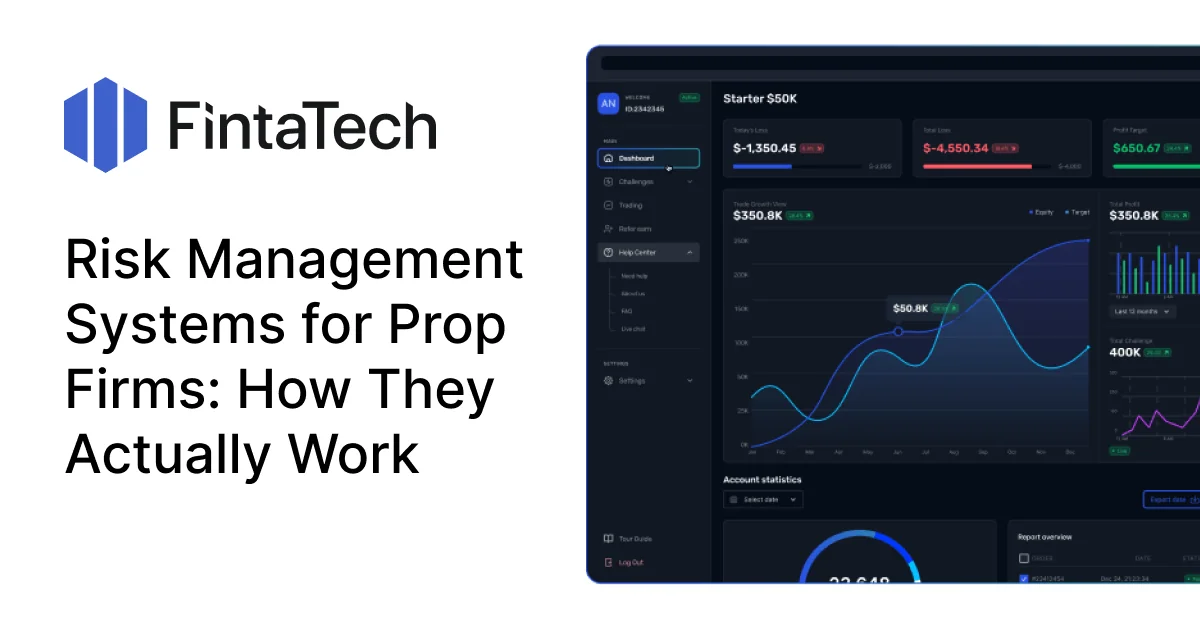
Prop trading has grown into a sophisticated industry. Thousands of firms now evaluate traders through structured challenges, fund successful ones, and scale capital allocation based on performance. The model is relatively straightforward to understand, but the technology required to run it reliably is anything but.
At the center of every operational prop firm is risk management. Not as a policy document. Not as a manual review process. As a live, real-time system that monitors every account, enforces every rule, and prevents problems before they compound. Firms that treat risk management as an afterthought tend to find out why it matters at the worst possible moment.
More Than Rules on Paper
Risk management in a prop firm context is often misunderstood as a set of static thresholds, a maximum drawdown here, a daily loss limit there. In practice, it is far more dynamic than that.
A functioning risk system is a continuous feedback loop between trading activity, account state, and business logic. It needs to know what every trader is doing right now, what their account looks like at this moment, and whether their current trajectory puts the firm at risk. This requires real-time data ingestion, rule evaluation at the account level, and the ability to act on violations instantly, whether that means freezing an account, triggering a notification, or flagging a case for review.
The difference between a firm that survives scaling and one that collapses under the weight of it often comes down to whether this system was built properly from the start.
The Core Components
A modern prop firm risk system typically operates across several interconnected layers.
Drawdown and loss controls are the foundation. Maximum drawdown limits — both trailing and static — define the outer boundary of how much loss a trader can accumulate before their account is suspended or closed. Daily loss limits operate on a shorter time horizon, resetting each session and preventing traders from digging deep holes in a single day. These rules sound simple, but enforcing them correctly across hundreds or thousands of simultaneous accounts requires a system that tracks equity in real time, not just at end-of-day snapshots.
Consistency rules add another dimension. Many firms require traders to demonstrate stable performance rather than single-day windfalls. A system that monitors the distribution of daily returns and flags anomalies — one session accounting for 70% of total profits, for example helps firms distinguish between genuine edge and luck-driven outliers. Enforcing consistency rules in an automated way, with clear audit trails, is something that needs deliberate engineering, not spreadsheets.
Behavioral and pattern monitoring sits above the rule layer. This is where a risk system starts to look more like a compliance engine. Unusual trading patterns, exploitative strategies, abuse of news events, hedging between accounts, these are behaviors that rules alone often fail to catch. Effective prop firm risk infrastructure includes logic that surfaces anomalous patterns and presents them to operations teams, so that human judgment can be applied where automation has limits.
Fraud and multi-account detection is increasingly important as the industry matures. Traders who operate multiple accounts to hedge across them, who share strategies with outside parties, or who systematically exploit evaluation mechanics represent a real financial risk to firms. Identifying these behaviors requires cross-account analysis at the infrastructure level, not just individual account monitoring.
Payout-related controls close the loop. Before a trader reaches payout eligibility, the system needs to verify that all rules were followed throughout the evaluation period, that there are no pending flags, and that the account history is clean. Automating this verification — rather than running it manually for each payout request — is what allows firms to scale without adding headcount linearly.
Connection to the Broader Stack
A risk management system does not operate in isolation. It is tightly coupled with every other layer of prop firm infrastructure.
The trading platform feeds its live position and equity data. The account management system provides trader status, progression history, and configuration. The rules engine needs access to both to evaluate whether a trader is operating within their defined parameters at any given moment. When a violation occurs, the system needs to communicate outward, to the trading platform to halt activity, to the CRM to log the event, to the trader dashboard to display the relevant status update.
This is why prop firms built on disconnected tools struggle. When risk logic lives in one place, trading activity in another, and account state in a third, the firm is perpetually operating on delayed or incomplete information. The risk system becomes reactive rather than preventive.
Firms that have built — or adopted — tightly integrated infrastructure are able to catch problems early, enforce rules consistently, and operate with a level of confidence that disconnected stacks simply cannot provide. Fintatech’s prop firm technology is built with this integration in mind, combining trading infrastructure, account management, and risk controls into a unified system rather than a collection of loosely connected parts. More on the approach is available at fintatech.com/prop-firm.
What Breaks When Risk Management Is Weak
The consequences of inadequate risk infrastructure tend to emerge gradually, then all at once.
In the early days of a firm, manual oversight is often enough. A small number of accounts can be reviewed individually. Violations can be caught after the fact. Payouts can be verified one by one. This creates a false sense of stability, the firm appears to be functioning well, but only because volume hasn’t exposed the cracks.
As trader volume grows, manual processes collapse. A risk team that could review fifty accounts now faces five thousand. Edge cases that were manageable exceptions become systematic exploits. Payouts take days to verify. Traders who should have been suspended continue operating because no one caught the breach in time.
The financial exposure that accumulates during this lag is real. So is the operational burden of unwinding the damage, suspending accounts retroactively, disputing payouts, handling trader complaints. Firms that have been through this experience tend to invest in proper infrastructure afterward. The firms that build it before they need it scale more cleanly and retain better reputations with their trader base.
Scaling Without Adding Chaos
The goal of a well-built risk system is not just to prevent losses, it is to make growth manageable. When risk enforcement is automated, consistent, and integrated with the rest of the platform, a firm can double its trader base without doubling its operations team. Rules are applied uniformly, regardless of volume. Payouts are verified programmatically. Anomalies surface automatically, rather than waiting to be discovered.
This is the operational model that separates firms which scale sustainably from those that grow into complexity they cannot manage. The technology is not the whole story — strategy, marketing, and trader quality all matter, but the infrastructure sets the ceiling on how far any of those other factors can take you.
Risk management in a prop firm is not a compliance checkbox. It is the operational backbone of the business. Building it correctly from the start, or upgrading it before the cracks appear, is one of the more consequential decisions a prop firm operator can make.
Conclusion
The prop trading industry has moved fast. What started as a relatively niche model has expanded into a global market with thousands of firms, millions of traders, and significant capital at stake. That growth has raised the bar for what it takes to operate reliably.
Risk management is no longer something firms can figure out as they go. The firms that are building for longevity are treating it as a core engineering concern integrated with their trading infrastructure, automated wherever possible, and designed to scale without breaking. Those that are still patching together manual processes and disconnected tools will eventually face the consequences at a moment they cannot afford.
Getting this right is not just about limiting losses. It is about building a business that can grow confidently, pay out traders consistently, and operate without constant operational firefighting. That is the standard worth building toward, and it starts with taking the infrastructure seriously from day one.


Twitter
Linkedin
Facebook