
The landscape of Trading Platform development is undergoing a massive shift. Ask a modern AI coding assistant to write a sorting algorithm or set up a database schema, and you will likely receive perfect code in seconds. Artificial intelligence has fundamentally accelerated how we build backend software.
However, when engineering teams attempt to use these same AI tools to integrate a professional-grade, multi-asset trading chart into their platform, the experience usually breaks down. The result is often hallucinated configurations, deprecated API calls, and a broken user interface that requires hours of manual human debugging.
At Fintatech, we realized the problem does not lie with the AI models. The problem is the charting libraries themselves.
Legacy financial components were built and documented for human engineers. They rely on human intuition to bridge the gaps in documentation. Large Language Models (LLMs) like Claude Code, Codex and GitHub Copilot lack human intuition. They require determinism, perfectly structured types, and machine-readable context.
To truly accelerate FinTech development, we needed to rethink Developer Experience (DX) for an era where the developer writing the code might be an AI agent. This article explores the challenges of AI-assisted UI development and how we re-engineered the FintaChart financial charting library to speak the language of AI natively.
The Complexity of Financial Chart Integration
When a brokerage or prop trading firm begins a Trading Platform development project, the charting interface is often the most resource-intensive front-end component.
Unlike standard web elements, an HTML5 trading chart is a complex, stateful application living inside the browser. It must handle rendering thousands of data points via WebGL or Canvas, manage real-time WebSocket data streams, and update seamlessly without freezing the user’s browser.
Furthermore, professional traders demand deep functionality. A standard integration requires configuring:
- Real-time data feeds for Forex, Crypto, and Equities.
- Dozens of technical indicators (Moving Averages, MACD, RSI).
- Interactive drawing tools (Fibonacci retracements, trend lines).
- Complex multi-chart layouts and customized color themes.
Historically, configuring these elements required a developer to spend days reading through hundreds of pages of API documentation. When teams try to offload this task to an AI coding assistant, the AI typically fails because the configuration objects are highly specific and deeply nested. If the AI cannot easily parse the exact structure expected by the charting library, it will hallucinate a structure that looks correct but fails at runtime.
Re-engineering for the AI Agent
We recognized that if we want our clients to achieve faster speed-to-market, our tools must be optimized for modern workflows. Over the past few months, the Fintatech engineering team took on a unique challenge: optimizing our premier charting library, FintaChart, to be natively understood by AI coding assistants.
We stopped fighting the AI and started speaking its language. We restructured our entire approach to documentation and API design.
1. Machine-Readable Documentation
We overhauled our repository structures and documentation formats. While human-readable guides are still essential, we implemented structured context files (like llms.txt) designed specifically for AI crawlers. These files provide LLMs with a clean, concise, markdown-formatted map of our entire API surface, stripping away marketing fluff and focusing purely on deterministic code structure.
2. Strict TypeScript Definitions
LLMs thrive on strongly typed languages. By enforcing strict, comprehensive TypeScript interfaces across the entire FintaChart library, we ensure that an AI agent knows exactly what data types are required for every indicator, drawing tool, and layout configuration. The AI no longer has to guess; the types provide a rigid blueprint for success.
3. Predictable State Management
We simplified how the chart’s state is managed. When an AI agent generates the code to add a new technical indicator or switch a data feed, the required API calls are logical and predictable.
The result of this engineering effort is a charting engine that AI agents can configure and deploy flawlessly on the first try.
Behind the Scenes: Claude Code Meets FintaChart
To demonstrate what this “AI-Native” developer experience looks like in practice, our team put it to the test using Anthropic’s Claude Code.
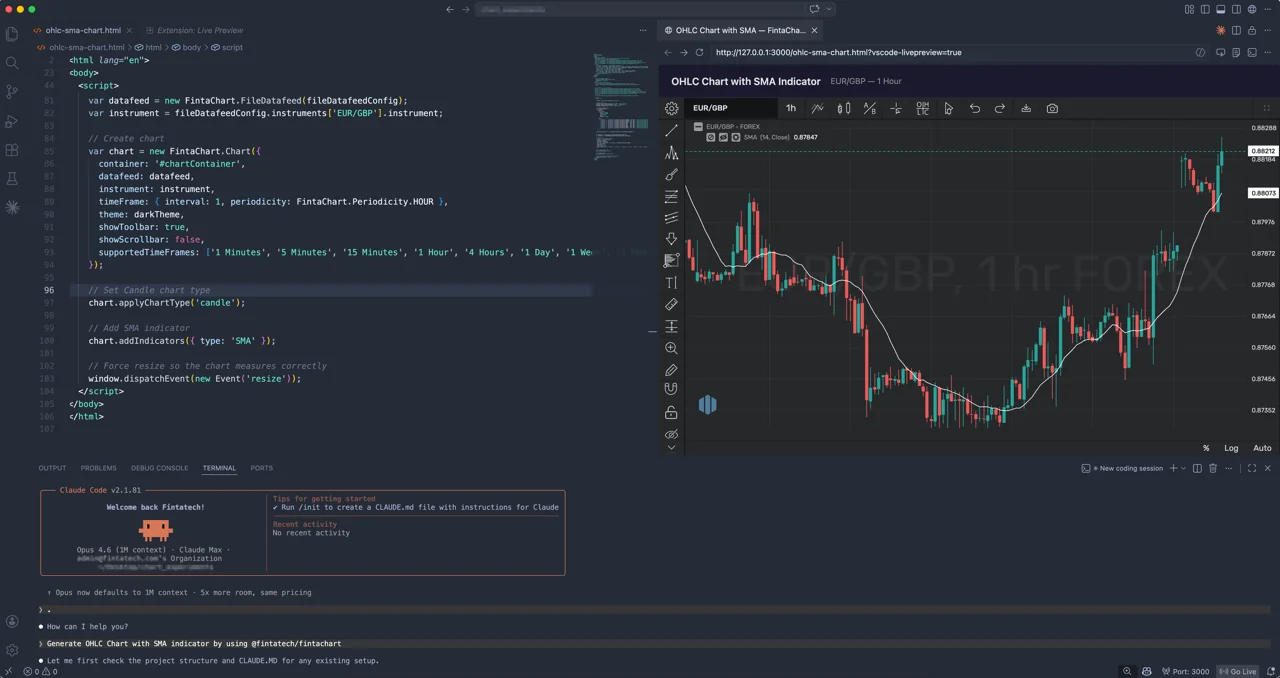
As you can see in the execution above, the integration process changes fundamentally when the library is optimized for the agent.
Zero Hallucinations
Because the FintaChart architecture provides machine-readable context, Claude Code understands exactly which modules to import and which methods to call. It does not hallucinate generic charting configurations. It accurately maps the user’s prompt directly to FintaChart’s specific advanced feature set.
Complex Configurations on the Fly
In this demonstration, we asked the AI to initialize a multi-asset chart, connect a real-time data stream, and apply specific technical indicators. Claude Code was able to generate the exact, production-ready code snippet required to render the full trading cockpit.
Instant Deployment
What traditionally takes a front-end developer several days of reading documentation, writing boilerplate code, and trial-and-error debugging can now be accomplished through a well-structured prompt in minutes. The AI handles the heavy lifting of the UI plumbing, allowing the human developer to simply review and deploy.
The Business Impact for Brokers and Prop Firms
For CTOs and founders building the next generation of financial products, this AI optimization provides a massive operational and commercial advantage.
Whether you are building a proprietary trading system from scratch or looking for a White-label Trading Platform solution, speed-to-market is your most critical metric. The longer your engineering team spends fighting with third-party charting APIs, the longer it takes to acquire users and generate revenue.
By using an AI-ready component like FintaChart, you remove the UI bottleneck entirely.
Your human engineers can focus their expensive time on core business logic, trade execution speed, security, and unique platform features. You can delegate the tedious integration of the data visualization layer to their AI co-pilots. This fundamentally collapses the timeline for launching a professional trading business.
It also drastically reduces ongoing maintenance costs. When a new feature or indicator needs to be added to your platform’s chart, your developers can prompt their AI assistant to generate the update, secure in the knowledge that the AI understands the underlying charting library perfectly.
Join the FintaChart AI Developer Beta
The future of building financial software is not just human. It is a powerful, collaborative mix of human engineers and intelligent AI agents working together.
To ensure our partners stay ahead of this technological curve, we have officially opened The FintaChart AI Developer Beta. We are inviting a select group of developers, CTOs, and technical founders to get early access to our AI-optimized repositories and build with us.
If your engineering team is actively engaged in Trading Platform development and you are using tools like Claude Code, Codex, Google Gemini, or GitHub Copilot to accelerate your workflow, you need components that are built for the job.
Don’t let legacy charting libraries slow down your AI adoption. Experience what happens when your UI components speak the same language as your developers.
Request Access to the Beta / Contact Us to learn how FintaChart can accelerate your platform launch today.

Twitter
Linkedin
Facebook