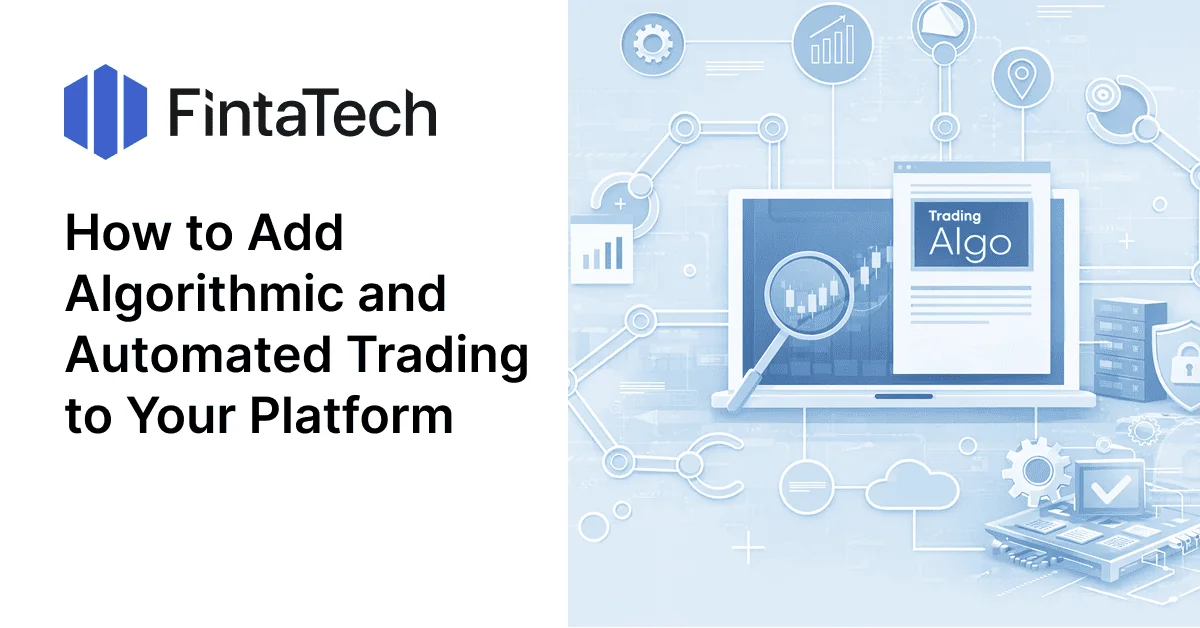
Algorithmic and automated trading are no longer optional features for modern trading platforms. They represent the technological backbone of today’s financial markets, enabling platforms to offer high-speed execution, intelligent strategy automation, advanced risk management, and seamless scalability. What once required dedicated quantitative teams, proprietary infrastructure, and millions in capital is now expected functionality even in retail and mid-sized trading platforms.
As competition intensifies across crypto exchanges, stock brokers, prop trading firms, and fintech startups, the ability to provide reliable, flexible, and secure automation becomes a decisive factor in user acquisition, engagement, and long-term retention. Traders increasingly expect programmable trading environments, access to real-time APIs, customizable bots, advanced strategy frameworks, and transparent execution pipelines.
From a business standpoint, algorithmic trading dramatically increases trading volume, improves liquidity, boosts user lifetime value, and creates opportunities for new monetization models, including premium automation tools, strategy marketplaces, and API subscription tiers. However, building such infrastructure requires careful architectural planning, deep technical expertise, and a comprehensive understanding of trading mechanics.
This article explores how to design and implement a full-scale algorithmic and automated trading ecosystem, covering API architecture, trading bots, strategy engines, data infrastructure, execution logic, security, and scalability.
Building a Robust Algorithmic Trading Infrastructure
At its core, algorithmic trading infrastructure is a multi-layered system that integrates market data ingestion, strategy computation, order execution, risk management, and user interaction. Each layer must be designed to operate with minimal latency, maximum reliability, and full fault tolerance, as even microsecond delays or minor system failures can translate directly into financial losses.
A modern trading platform typically begins with a real-time market data layer capable of processing millions of events per second. This data includes live price feeds, order book updates, trade executions, funding rates, liquidation events, and market-wide indicators. The data must be normalized, timestamped, validated, and distributed across internal services with extremely low latency. High-performance event streaming systems, combined with in-memory data stores and distributed caching, are commonly used to achieve the necessary throughput and consistency.
Above this layer sits the strategy engine, which continuously evaluates incoming market data, applies mathematical models, and generates trading signals. These strategies can range from simple indicator-based rules to advanced statistical arbitrage systems and AI-driven predictive models. The strategy engine must be capable of parallel computation, multi-timeframe analysis, portfolio-level optimization, and cross-market correlation processing.
Once signals are generated, the execution layer translates them into actionable orders. This process involves order routing, slippage modeling, smart order splitting, liquidity detection, and dynamic execution adjustments. Advanced platforms implement execution algorithms such as TWAP, VWAP, and iceberg orders to minimize market impact and optimize fills. The execution layer must operate deterministically, guaranteeing consistency even under extreme market volatility.
Finally, all trading actions pass through a real-time risk management and compliance layer. This ensures that every order complies with predefined risk constraints, regulatory requirements, and platform-level safety mechanisms. Automated liquidation engines, exposure monitoring, margin calculations, and anomaly detection systems work continuously to protect both users and the platform itself.
API Architecture: The Foundation of Algorithmic Trading
The API layer serves as the primary gateway between external trading systems and your internal trading engine. It defines how developers, institutions, trading bots, and automated strategies interact with your platform. In practice, API quality often determines whether professional traders choose your platform or migrate to competitors.
A production-grade trading API must offer deterministic performance, predictable response times, and full transparency in execution reporting. Traders rely on APIs for real-time market data, order placement, position management, balance tracking, historical data retrieval, and event subscriptions. Any instability, latency spikes, or undocumented behavior directly impacts trading results and undermines platform credibility.
Low latency is particularly critical for high-frequency and arbitrage strategies. To achieve this, APIs must be built using highly optimized networking stacks, asynchronous processing models, horizontal scaling, and regional edge deployment. WebSocket streams are typically used for real-time data distribution, while REST or gRPC endpoints handle transactional operations.
Security is equally critical. Authentication must rely on strong cryptographic standards, granular permission scopes, IP whitelisting, and rate limiting. Each API key should allow fine-grained access control, enabling traders to isolate read-only, trading-only, and fund management permissions. Advanced platforms also implement behavioral analytics and anomaly detection to identify suspicious activity patterns in real time.
Comprehensive documentation, SDK libraries, sandbox environments, and example strategies are essential for rapid onboarding. A strong developer experience not only reduces support costs but also accelerates ecosystem growth, enabling third-party innovation and community-driven expansion.
Strategy Engines and Automated Execution Logic
The strategy engine represents the cognitive core of automated trading. It transforms raw data into actionable decisions using predefined logic, mathematical models, and statistical analysis. Unlike manual trading systems, where human judgment filters noise and anomalies, automated strategies must rely entirely on robust signal processing, error handling, and probabilistic modeling.
Modern strategy engines typically support a hybrid approach that combines deterministic rule-based systems with probabilistic and machine learning models. This allows traders to build adaptive strategies capable of adjusting to changing market regimes, volatility conditions, and liquidity environments.
The execution layer must operate as an extension of the strategy engine, continuously optimizing order placement to achieve optimal fills while minimizing transaction costs. This involves real-time monitoring of market depth, spread fluctuations, liquidity fragmentation across venues, and dynamic fee structures.
To maintain execution integrity, platforms often deploy redundant execution paths, intelligent failover systems, and transaction replay mechanisms. These safeguards ensure that orders are either executed correctly or safely rolled back without leaving orphaned positions or exposure imbalances.
Trading Bots: User Experience, Automation, and Platform Growth
Trading bots represent the most user-facing implementation of algorithmic trading. They abstract complex strategy logic into accessible tools that allow traders to automate their strategies without writing code. For platforms, bots are a powerful engagement and monetization mechanism.
A mature bot ecosystem provides users with visual strategy builders, parameterized templates, backtesting environments, paper trading modes, and real-time performance analytics. By lowering technical barriers, platforms enable broader adoption of algorithmic trading, significantly expanding their active user base.
From a UX perspective, transparency is essential. Traders must be able to inspect strategy logic, monitor real-time decisions, understand execution outcomes, and audit performance metrics. Black-box automation erodes trust, especially during periods of drawdown or high volatility.
From a business perspective, bots unlock new revenue streams, including premium subscriptions, strategy marketplaces, revenue sharing programs, and institutional licensing. Platforms that cultivate vibrant bot ecosystems often develop powerful network effects, where external developers continuously contribute innovation, creating a self-reinforcing growth cycle.
Data Infrastructure and Real-Time Analytics
Algorithmic trading is fundamentally data-driven. High-performance platforms invest heavily in real-time analytics pipelines capable of processing massive data streams with microsecond latency.
This includes ingestion of market feeds, order book aggregation, volatility modeling, liquidity metrics, sentiment analysis, and cross-market arbitrage detection. These analytics feed directly into strategy engines, enabling dynamic risk adjustments, adaptive position sizing, and real-time portfolio optimization.
To support this, platforms typically deploy distributed data pipelines, event-driven microservices, and scalable in-memory computation frameworks. Observability systems continuously monitor data integrity, throughput, latency, and error rates, ensuring that any anomaly is detected before it impacts trading decisions.
Risk Management, Compliance, and Platform Security
Automated trading dramatically amplifies risk exposure. Without strict controls, algorithmic systems can generate catastrophic losses within seconds. Therefore, risk management must be deeply embedded into every layer of the trading infrastructure.
Real-time pre-trade checks enforce exposure limits, leverage constraints, margin requirements, and portfolio diversification rules. Post-trade analytics continuously monitor performance, detect abnormal patterns, and trigger emergency shutdowns when necessary.
From a regulatory perspective, platforms must maintain comprehensive audit logs, transaction histories, compliance reporting, and identity verification systems. This is especially critical for platforms operating across multiple jurisdictions with differing regulatory frameworks.
Security measures must protect not only user funds but also algorithmic strategies, proprietary models, and platform infrastructure. End-to-end encryption, hardware security modules, intrusion detection systems, and continuous vulnerability scanning form the foundation of a secure trading ecosystem.
Strategic Value of Automation for Trading Platforms
Beyond technical considerations, algorithmic trading fundamentally reshapes platform economics. Automated systems operate continuously, generating consistent transaction volume, improving liquidity, and stabilizing order flow. This creates a virtuous cycle where increased liquidity attracts more traders, further reinforcing platform dominance.
Additionally, automation enables the creation of complex financial products such as structured portfolios, systematic funds, managed accounts, and AI-powered advisory services. These products significantly increase platform stickiness and open high-margin enterprise revenue channels.
Platforms that invest early in algorithmic infrastructure position themselves as long-term industry leaders, capable of adapting to rapid market evolution, regulatory changes, and emerging asset classes.
Conclusion
Adding algorithmic and automated trading to your platform is not merely a technical upgrade — it is a strategic transformation. It requires deep integration across system architecture, data pipelines, execution engines, security frameworks, and user experience design.
When executed correctly, automation becomes a growth engine, unlocking exponential scalability, stronger user loyalty, and long-term competitive advantage. In an increasingly data-driven financial world, platforms that master algorithmic trading infrastructure will define the future of digital trading.


Twitter
Linkedin
Facebook