
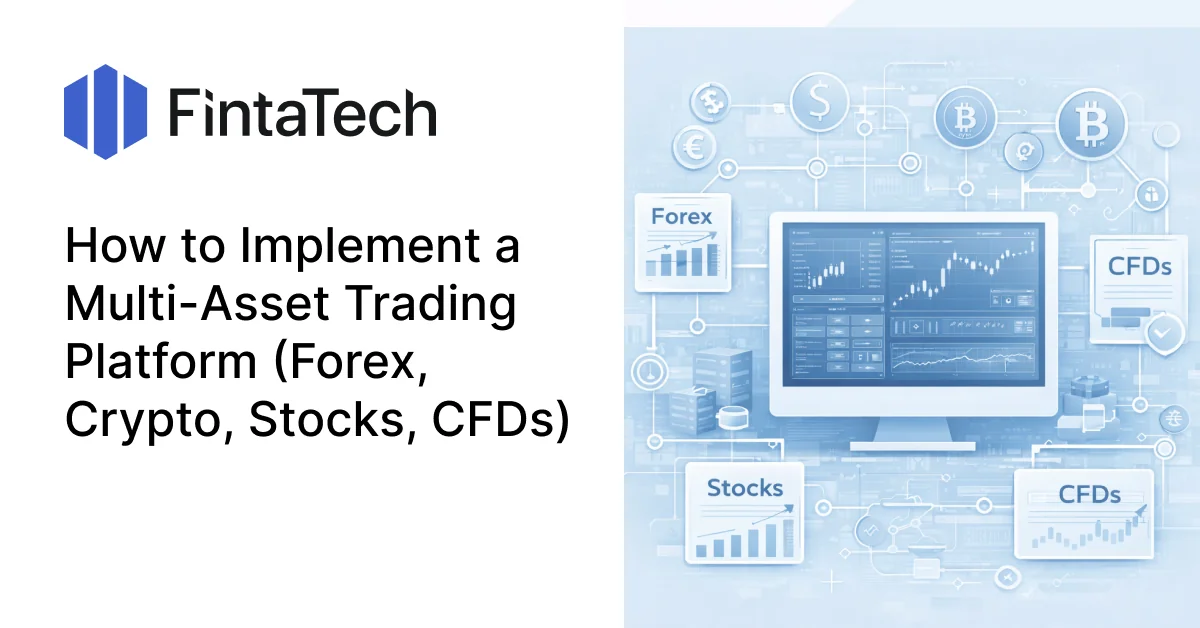
Building a modern multi-asset trading platform requires a strategic combination of financial domain expertise, advanced software architecture, regulatory knowledge, and scalable infrastructure engineering. Unlike single-asset platforms, multi-asset systems must simultaneously support fundamentally different market structures, execution models, regulatory regimes, and liquidity mechanisms. Forex, cryptocurrencies, stocks, and CFDs operate under unique technological and legal frameworks, which significantly increases system complexity. At the same time, market demand for unified trading ecosystems continues to grow, driven by retail and institutional traders seeking seamless access to diversified financial instruments from a single interface. Users increasingly expect real-time execution, unified portfolios, advanced analytics, and consistent user experience across all asset classes. This convergence of expectations forces fintech companies to design platforms that can abstract complexity while maintaining performance, accuracy, and regulatory compliance. Achieving this balance requires careful planning of system architecture, data pipelines, execution engines, and compliance workflows. When executed properly, a multi-asset trading platform becomes a scalable digital infrastructure capable of supporting global market expansion. In this article, we explore a comprehensive framework for designing, developing, and implementing a high-performance multi-asset trading platform optimized for modern fintech ecosystems.
Understanding the Complexity of Multi-Asset Trading Platforms
Multi-asset trading platforms introduce a level of complexity that goes far beyond traditional brokerage software. Each asset class brings unique trading mechanics, settlement processes, market data structures, and regulatory obligations. Forex trading relies on decentralized liquidity pools, requiring real-time price aggregation from multiple liquidity providers and ultra-low latency execution. Cryptocurrency trading operates continuously, twenty-four hours a day, with extreme volatility, fragmented liquidity across exchanges, and complex custody requirements. Stock trading depends on centralized exchanges, strict compliance procedures, and regulated settlement cycles, often involving multiple intermediaries. CFDs combine elements of multiple markets while introducing broker-side exposure, synthetic pricing, and internal risk management challenges. Designing a unified platform that supports all these models requires advanced system abstraction and modular architecture. Without careful planning, development teams risk building rigid systems that cannot scale or adapt to evolving market conditions. Furthermore, traders expect consistent interaction patterns across all asset types, even though the backend logic differs significantly. This forces product teams to bridge deep technical complexity with intuitive user experience. Ultimately, successful multi-asset platform development depends on aligning business strategy, regulatory foresight, and software engineering best practices into a cohesive technological framework.
Defining the Business Model and Regulatory Strategy
Before initiating technical development, fintech companies must define their business model and regulatory positioning, as these factors shape every aspect of platform architecture. Multi-asset trading platforms may operate as brokerages, technology providers, white-label solution vendors, or hybrid financial ecosystems, each requiring different compliance obligations and operational processes. Forex and CFD trading often demand brokerage licenses, strict capital adequacy standards, and comprehensive reporting obligations. Stock trading introduces exchange connectivity, clearing agreements, and settlement compliance, which vary significantly across jurisdictions. Cryptocurrency trading adds layers of regulatory uncertainty, requiring dynamic compliance frameworks that adapt to evolving legislation. A well-defined regulatory strategy influences onboarding flows, KYC and AML workflows, transaction monitoring, and data retention policies. It also determines how user accounts, wallets, and custody systems are structured. Failing to incorporate regulatory requirements at the architectural stage often leads to costly platform redesigns and delayed product launches. Moreover, global expansion requires flexible compliance frameworks capable of supporting multiple regulatory environments simultaneously. Therefore, regulatory strategy should not be treated as a constraint, but as a foundational design principle for building scalable and sustainable trading platforms.
Designing Scalable and Modular System Architecture
Scalable system architecture is the cornerstone of any successful multi-asset trading platform. The platform must process massive volumes of real-time market data, execute thousands of trades per second, and continuously recalculate user risk exposure. Traditional monolithic architectures struggle under such workloads, making microservices-based and event-driven architectures far more suitable. By separating key components such as order management, pricing engines, risk calculation modules, market data processing, and user account services, platforms gain flexibility, fault isolation, and horizontal scalability. Event streaming frameworks allow real-time synchronization between distributed components, ensuring system-wide data consistency. Cloud-native deployment strategies further enable dynamic scaling during peak trading hours and volatile market conditions. High-performance caching layers minimize latency while preserving data accuracy. Additionally, separating transactional workloads from analytical workloads enables real-time reporting, monitoring, and compliance analytics without degrading trading performance. Without such architectural principles, platforms often suffer from performance bottlenecks, operational instability, and limited scalability. Therefore, modern multi-asset platforms require engineering strategies built for elasticity, resilience, and continuous growth.
Developing a Unified Trading Engine for Multiple Asset Classes
The trading engine serves as the operational core of any multi-asset platform and must support a wide range of execution models. Forex execution relies on streaming quotes, market and limit orders, and ultra-fast routing to liquidity providers. Crypto trading involves centralized or decentralized order book matching, real-time depth tracking, and blockchain settlement integration. Stock trading depends on exchange routing, regulatory compliance checks, and post-trade clearing workflows. CFD execution requires internal pricing engines, synthetic order generation, and broker-side exposure management. A unified trading engine must abstract these diverse behaviors into a consistent execution framework while preserving asset-specific logic. This requires adaptable order lifecycle management, configurable execution pipelines, and dynamic pricing engines. Real-time margin calculations and risk checks must adapt continuously to market volatility and leverage profiles. Furthermore, the engine must support advanced order types, partial fills, hedging strategies, and liquidity aggregation. Without a unified execution framework, development teams often build fragmented systems that are difficult to scale and maintain. Therefore, designing a flexible and modular trading engine is essential for long-term platform stability and extensibility.
Integrating Market Data and Liquidity Infrastructure
Reliable market data and liquidity integration represent one of the most technically demanding components of a multi-asset trading platform. Forex pricing requires continuous aggregation from multiple liquidity providers, normalization of bid-ask spreads, and real-time failover handling. Cryptocurrency data flows involve high-frequency updates from fragmented exchanges, dynamic order book synchronization, and cross-venue arbitrage prevention. Stock market data requires certified exchange feeds, strict compliance with data distribution agreements, and highly resilient data delivery pipelines. CFDs depend on synthetic price construction, often derived from multiple underlying instruments and dynamic markup strategies. A unified market data layer must normalize all inputs into consistent internal representations while preserving accuracy and precision. Low-latency streaming pipelines ensure traders receive real-time quotes, even during extreme market volatility. Historical data storage systems must support deep analytics, regulatory reporting, and machine learning workflows. Implementing redundancy, validation layers, and automated anomaly detection is essential to prevent execution errors and price manipulation risks. Ultimately, robust market data architecture directly influences execution quality, platform reliability, and trader trust.
Implementing Advanced Risk Management and Compliance Systems
Risk management is exponentially more complex in multi-asset environments, where volatility, leverage, and settlement risks vary dramatically across instruments. Forex and CFDs involve high leverage, demanding real-time margin monitoring, liquidation engines, and exposure tracking. Cryptocurrency trading introduces extreme price swings, custody risks, and operational vulnerabilities. Stock trading requires strict settlement compliance, position limits, and regulatory surveillance. A unified risk engine must continuously evaluate user portfolios, market exposure, and platform liabilities across all asset classes. This involves dynamic margin calculations, real-time stress testing, and automated liquidation workflows. Compliance systems must enforce KYC, AML, transaction monitoring, suspicious activity detection, and regulatory reporting. Audit trails, event logs, and regulatory data pipelines must operate continuously and reliably. Failure to implement robust risk and compliance frameworks exposes platforms to financial losses, regulatory sanctions, and reputational damage. Therefore, risk management should be deeply embedded into platform architecture rather than implemented as an external control layer.
Building a Seamless and Consistent User Experience
Despite the technical complexity of multi-asset trading, users expect intuitive, fast, and seamless platform interactions. A well-designed user interface must abstract backend complexity while preserving transparency and control. Traders should be able to move effortlessly between forex, crypto, stocks, and CFDs without encountering inconsistent workflows or design patterns. Portfolio dashboards must present aggregated views of positions, margins, and performance across all markets. Order entry interfaces should dynamically adapt to asset-specific parameters while maintaining consistent user interactions. Advanced charting, real-time indicators, and analytical tools must operate uniformly across asset classes. Performance optimization is critical, as latency or interface lag can immediately undermine trading confidence. Additionally, features such as alerts, automated strategies, and personalized analytics significantly enhance user engagement and retention. By prioritizing usability alongside performance, platforms can serve both retail and professional traders effectively. Ultimately, superior user experience becomes a key competitive advantage in the crowded fintech marketplace.
Ensuring Security, Reliability, and Global Scalability
Security and infrastructure resilience are foundational requirements for any multi-asset trading platform. The system must protect sensitive user data, financial assets, and transactional workflows from cyber threats and operational failures. Advanced authentication mechanisms, encryption standards, and access control systems prevent unauthorized access. Crypto custody introduces additional security layers, including cold storage, hardware security modules, and secure transaction signing protocols. Infrastructure redundancy, geographic failover, and disaster recovery planning ensure uninterrupted platform operation during market stress events. High availability architecture minimizes downtime, while continuous monitoring enables proactive issue detection. Scalability planning ensures that the platform can grow alongside increasing user demand and trading volumes. Without these safeguards, even minor failures can escalate into systemic risks. Therefore, security and reliability must be embedded at every architectural layer, from frontend interfaces to backend execution engines and data pipelines.
Strategic Approach to Multi-Asset Platform Development
Developing a multi-asset trading platform is a long-term strategic investment that requires deep fintech expertise, regulatory foresight, and architectural discipline. Successful platforms combine modular system design, advanced risk management, regulatory compliance, and superior user experience into a cohesive ecosystem. While technical complexity is high, the commercial potential is even greater, as traders increasingly demand unified access to diversified markets. By adopting scalable architectures, data-driven decision-making, and continuous innovation, fintech companies can build resilient platforms capable of supporting global expansion. In an increasingly competitive financial technology landscape, multi-asset trading platforms represent the future of digital brokerage infrastructure. Companies that invest in robust architecture today position themselves as market leaders tomorrow.


Twitter
Linkedin
Facebook