
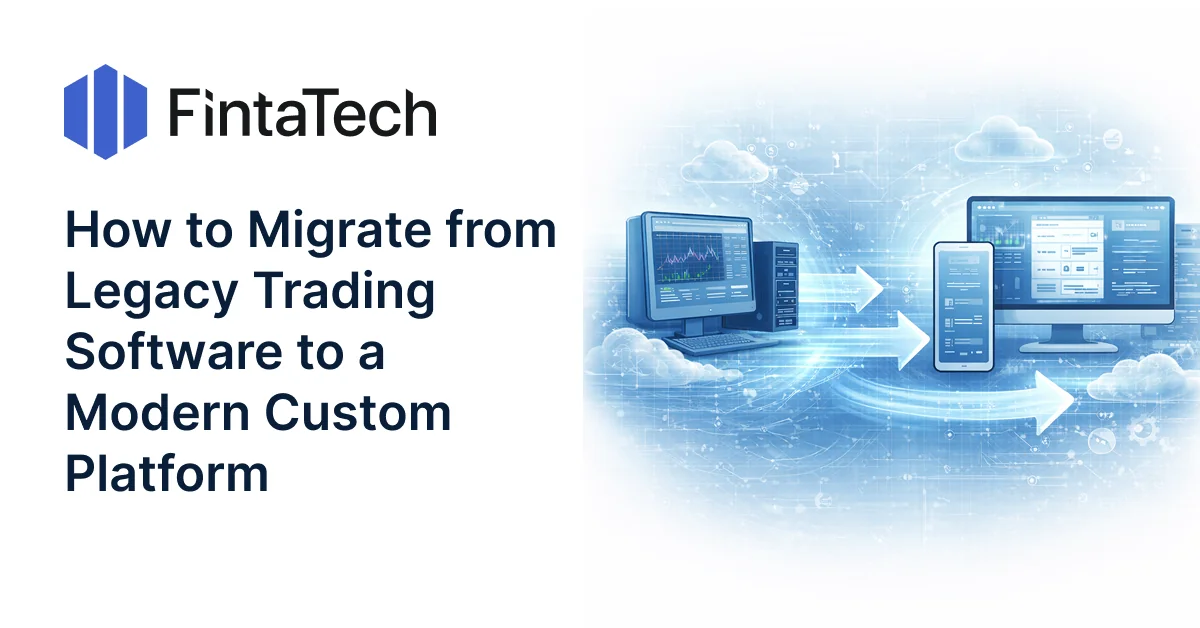
here’s a specific kind of silence that falls over a trading floor when a system goes down during peak volatility. Every second of downtime is measurable in missed executions, client attrition, and regulatory exposure. For technology leaders at brokerages and fintech firms, this moment is often the breaking point — the event that finally forces the conversation about trading system modernization that should have happened years earlier.
But the organizations that move fastest aren’t the ones reacting to failure. They’re the ones that read the signals early, built an honest assessment of their technical debt, and executed a migration strategy that minimized business disruption while maximizing long-term capability. This article is for them.
Why Legacy Trading Software Becomes a Strategic Liability
Most legacy trading platforms didn’t start as liabilities. They were purpose-built solutions for the market conditions and regulatory environment of their era. The problem is that market microstructure, liquidity fragmentation, regulatory complexity, and client expectations have evolved dramatically — and monolithic, on-premise trading infrastructure simply cannot keep pace.
The architectural reality of most legacy systems is a tightly coupled codebase where the order management system, risk engine, reporting layer, and market data feeds are woven together in ways that make isolated changes nearly impossible. A change to the risk calculation logic requires touching modules that haven’t been reviewed in a decade. An integration with a new liquidity provider means negotiating with inflexible FIX adapters that were designed for a two-provider world. Adding a new asset class — say, crypto derivatives or structured products — may require a ground-up rewrite of business logic that the original architects never anticipated.
Beyond architecture, there’s the infrastructure problem. Legacy trading software often runs on bare-metal servers or aging virtualization layers that create hard ceilings on throughput. When markets spike and order volume triples in sixty seconds, these systems don’t scale — they queue, they lag, and sometimes they crash. The latency profile that was acceptable in 2010 becomes a competitive disadvantage when institutional clients are measuring execution quality in microseconds and routing flow to venues that perform better.
Vendor lock-in compounds the issue. Many brokerages are running platforms from vendors who have been acquired, sunset development, or restructured their licensing in ways that eliminate the original value proposition. The brokerage is now paying significant licensing fees for a system it can’t extend, can’t fully understand, and can’t migrate away from easily — because all the business logic lives inside a black box.
The financial consequences are real and escalating. Compliance costs rise as regulatory frameworks like MiFID II, EMIR, and Dodd-Frank require increasingly granular reporting that legacy systems weren’t designed to produce. Engineering hours consumed by workarounds and patches divert capacity from product development. And the opportunity cost of features that can’t be built — multi-asset support, white-label client portals, algorithmic execution tools — is harder to quantify but ultimately more damaging to competitive positioning.
Key Signs Your Legacy Trading Platform Is Holding Back Business Growth
Technology leaders often know intuitively that their trading infrastructure is holding the business back. But the political and organizational capital required to drive a migration demands a more precise diagnosis.
Watch for these indicators: engineering teams spending more than thirty percent of sprint capacity on maintenance and incident response rather than new features; recurring performance degradation during high-volatility sessions that leads to manual intervention or client complaints; failed or delayed integration projects with new liquidity providers, prime brokers, or third-party analytics tools; compliance teams flagging gaps in reporting capability for new regulatory requirements; and inability to onboard new client segments or asset classes within a competitive timeframe.
On the business development side, the signals are equally clear. If your sales team is losing institutional mandates because prospective clients require FIX protocol versions, API connectivity, or execution quality benchmarks your platform can’t support, the platform is actively costing you revenue. If your brokerage is expanding into new geographic markets but your system can’t support the local regulatory reporting framework or settlement currency, that expansion is slower and more expensive than it should be.
A brokerage scaling from its domestic market into Southeast Asian equities, for example, will find that legacy systems requiring manual configuration for each new market make the expansion economics unattractive. The same infrastructure that handles three liquidity providers badly handles twelve catastrophically.
How to Migrate a Trading Platform: Comparing Modernization Approaches
There is no universal migration path. The right strategy depends on the organization’s risk tolerance, timeline, technical debt severity, and competitive pressure. The four primary approaches each carry distinct tradeoffs.
Full replacement involves building or deploying an entirely new trading platform and cutting over from the legacy system on a defined date. This approach offers the cleanest outcome — a modern, coherent architecture without the constraints of legacy integration — but carries the highest execution risk. For smaller brokerages or firms with relatively contained business complexity, a full replacement with a well-defined scope can be the fastest path to a clean technical foundation.
Phased migration moves components of the trading infrastructure to modern architecture in sequential tranches. The order management system might migrate first, then the risk engine, then the reporting layer. This approach lets the organization realize incremental value while managing risk, but it requires careful design of the integration layer between legacy and modern components during the transition period. Done poorly, phased migration extends the timeline and creates a hybrid architecture that’s harder to maintain than either the old or new system in isolation.
Modular modernization is appropriate when the core trading engine is sound but surrounding capabilities — client-facing portals, reporting, compliance tooling, market data distribution — are the primary pain points. Here, modern modules replace legacy subsystems without touching the core, connected via APIs. This is the lowest-risk approach but may not address fundamental architectural limitations if the core platform itself is the bottleneck.
Microservices transformation involves decomposing the monolithic platform into independently deployable services — order routing, risk calculation, market data, reporting, authentication — each with its own data store and deployment lifecycle. This is the most architecturally ambitious approach and the most capable in terms of long-term scalability and maintainability. It’s also the most complex to execute, requiring significant investment in DevOps capability, service mesh infrastructure, and organizational discipline around API contracts.
For most mid-size brokerages, a combination of phased migration and microservices transformation represents the practical optimum: stabilize the core, modularize at the edges, and progressively refactor toward a fully decoupled architecture as organizational capability matures.
How to Migrate a Trading Platform: Comparing Modernization Approaches
The difference between a migration that succeeds and one that becomes a multi-year organizational crisis usually comes down to how rigorously the pre-migration phases are executed. Here is a framework that works in practice.
Infrastructure and codebase audit. Before any architecture decisions are made, conduct a comprehensive inventory of the existing system. Map every component, every integration point, every data flow, and every dependency. Identify the business processes that run through each component and the data volumes they handle. This audit will reveal the true scope of technical debt and surface the hidden complexity that derails migrations that skip this step.
Risk assessment. Classify every component and integration by migration risk — the combination of business criticality, data complexity, and technical coupling. Order execution and position management are high-criticality, high-risk components where errors have immediate financial and regulatory consequences. Internal reporting tools may be lower criticality and good candidates for early migration to build team capability and confidence.
Architecture redesign. Design the target architecture before writing a line of migration code. Define service boundaries, API contracts, data models, and the infrastructure layer. Decide where cloud-native deployment makes sense and where on-premise or hybrid configurations are required by latency constraints or regulatory data residency rules. The architecture should be explicit about latency requirements — sub-millisecond execution paths require different design choices than batch reporting pipelines.
Data migration planning. Trading systems accumulate years of transactional history, client records, positions, and audit logs that must migrate with full fidelity. Design the data migration strategy with the compliance and legal teams, not just engineering. Understand data residency requirements, retention obligations, and the audit trail continuity requirements for regulatory purposes. Test data migration with production-scale datasets, not samples.
Integration strategy. Map every external integration — FIX connections to liquidity providers, prime broker APIs, market data vendors, clearing houses, CRM and back-office systems — and design the modern integration layer. API-first architecture means every integration is defined by a stable contract, enabling components to evolve independently without cascading failures. Build integration testing into the migration plan, not as an afterthought.
Compliance alignment. Regulatory compliance requirements should be treated as first-class architectural constraints, not bolt-on features. Transaction reporting for MiFID II, best execution documentation, position limit monitoring, and AML transaction surveillance each have specific data and latency requirements. Engage your compliance and legal teams in the architecture review before the build phase, not during UAT.
Testing protocol. Trading system testing requires more than functional correctness. Stress testing under simulated peak load conditions, chaos engineering to validate failover behavior, and regression testing against historical market data scenarios are all essential. Build a testing environment that can replay real market events — a VIX spike day, a flash crash scenario, a major earnings announcement — and validate system behavior under those conditions.
Rollout and cutover. Plan the production cutover with the same rigor as a military operation. Define the go/no-go criteria explicitly. Establish clear rollback procedures and the conditions that trigger them. Run parallel operation of legacy and new systems for a defined period where feasible, comparing outputs to validate correctness. Have a war room staffed with engineering, operations, and business leadership during the initial go-live window.
Post-migration optimization. The work doesn’t end at cutover. Define performance baselines before go-live and measure against them continuously. The first ninety days of production operation will surface optimization opportunities — query patterns that need indexing, service boundaries that were drawn incorrectly, latency paths that need caching or co-location — that couldn’t be anticipated in design.
Advanced Technical Considerations for Modern Trading Platform Architecture
Cloud-native infrastructure enables horizontal scaling that legacy on-premise systems cannot match, but cloud deployment for trading infrastructure requires careful design. Latency-sensitive components — the order book, the matching engine, the risk engine — may require dedicated compute with specific networking configurations to meet execution quality requirements. Cloud-native infrastructure is most straightforwardly applied to market data distribution, reporting, analytics, and client-facing services, where elasticity provides direct business value.
Latency optimization in modern trading platforms requires attention at every layer: network topology, service communication patterns, data serialization, and database access patterns. Replacing legacy FIX processing with binary protocols, using in-memory data grids for position and risk data, and designing execution-critical services to avoid unnecessary network hops can collectively reduce latency by an order of magnitude compared to legacy systems.
Security and regulatory compliance in a microservices architecture requires explicit design attention that monolithic systems handle implicitly. Service-to-service authentication, encrypted data in transit and at rest, audit logging at the service boundary level, and role-based access control across distributed services all require deliberate implementation. Penetration testing and security review should be integrated into the development lifecycle, not treated as a pre-launch gate.
Disaster recovery planning for modern trading platforms should target recovery time objectives measured in minutes, not hours. Active-passive or active-active multi-region deployment, automated failover with health monitoring, and regular disaster recovery drills are the baseline expectation. The disaster recovery design should be tested, not documented.
Conclusion
The brokerages and trading firms that are winning market share in 2024 and beyond are not doing so on price alone. They’re winning on execution quality, product breadth, onboarding speed, and platform reliability. These capabilities are direct outputs of modern trading infrastructure.
Legacy trading software is a slow drain on competitive position. It’s not usually a crisis — it’s a compounding disadvantage. Every quarter spent managing technical debt is a quarter not spent building the features that attract the next tier of clients or the next asset class. Every performance incident during a volatility event is a data point that sophisticated clients use when they evaluate their prime brokerage or execution venue relationships.
The migration from legacy to modern is not a technical project with a business justification. It’s a business transformation with a technical execution plan. The organizations that approach it that way — with executive sponsorship, clear business objectives, realistic timelines, and experienced technology partners — are the ones that complete it successfully.
Fintatech works with brokerages and trading firms at exactly this inflection point: organizations that have outgrown their legacy infrastructure and need a strategic partner with deep experience in custom trading platform development, microservices architecture, and regulatory-compliant trading system modernization. If your organization is evaluating a migration strategy, the most valuable first conversation is an honest assessment of where your current infrastructure is constraining your business — and what a modern platform built specifically for your architecture requirements would change.
The firms that move deliberately and soon will spend the next decade competing on capability. The ones that wait will spend it managing debt.


Twitter
Linkedin
Facebook