
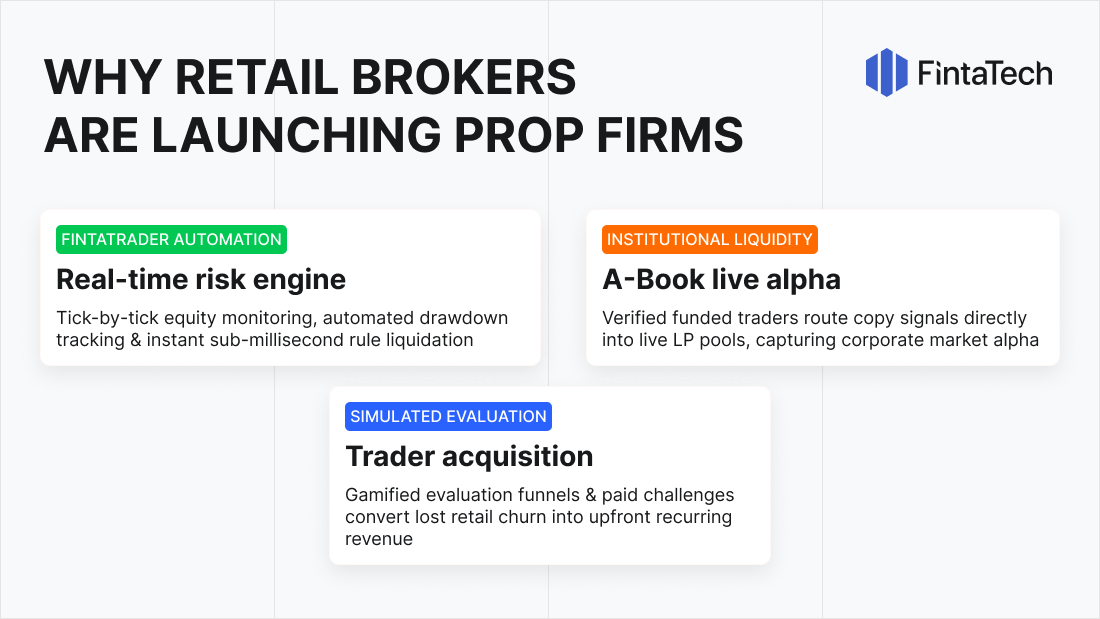
The financial trading industry is witnessing a massive strategic shift. Established retail brokerages are no longer relying solely on standard retail deposits to drive growth. Instead, they are actively launching proprietary trading firms, commonly known as funded trader programs, alongside their core operations. This is not a pivot away from retail brokerage; it is a calculated expansion.
By running a retail brokerage and a prop firm simultaneously, financial institutions can capture a much wider spectrum of the market. They secure their traditional revenue from well capitalized investors while unlocking a massive new revenue stream from skilled but undercapitalized traders. However, launching a parallel prop firm requires a specific technological infrastructure. Brokers cannot simply recycle their existing retail risk management tools. They need dedicated prop trading platform software designed to handle gamified evaluations, simulated liquidity, and automated account liquidation.
The Strategic Synergy of the Dual Model Approach
Operating a standard retail brokerage in the current financial climate comes with distinct challenges. Customer acquisition costs are high, and the market is saturated with competitors offering zero commission trading. While the retail B book model remains highly profitable, growth is becoming harder to sustain.
Launching a prop firm arm provides the perfect hedge and expansion mechanism. The prop firm model bypasses many of the traditional friction points of retail customer acquisition. It fundamentally changes the marketing hook. Instead of asking a client to risk their own life savings, the broker offers the client a chance to trade company capital after passing a paid evaluation.
| Business Metric | Retail Brokerage Arm | Proprietary Trading Arm |
|---|---|---|
| Target Demographic | Traders with personal capital ready to invest | Skilled or aspiring traders seeking larger capital |
| Core Revenue Stream | Spreads, commissions, and B book execution | Upfront evaluation fees and live profit splits |
| Client Motivation | Wealth generation through personal risk | Career advancement and risk free capital access |
| Execution Model | Standard hybrid A book or B book routing | Simulated during evaluation, A book routing for funded winners |
By operating both models, the brokerage creates a highly efficient internal ecosystem. If a retail trader loses their personal capital, they often leave the platform entirely. If the brokerage also owns a prop firm, that same trader can be cross sold an evaluation challenge, retaining them within the company ecosystem. Conversely, a successful prop firm trader who receives a massive payout might decide to open a standard retail account to invest their new wealth.
Solving the A Book Dilemma
One of the greatest operational challenges for a retail broker is risk management and execution routing. Brokers must decide which clients to place on the B book (holding the risk internally and profiting from client losses) and which to place on the A book (routing the trades directly to a liquidity provider).
Identifying consistently profitable retail traders is difficult. A trader might get lucky for a week, only to blow their account the next. If a broker incorrectly leaves a highly profitable institutional trader on the B book, the brokerage absorbs massive losses.
The prop firm model is the ultimate solution to the A book dilemma. The evaluation phases act as a rigorous, automated filtering system. The vast majority of traders who lack discipline will fail the challenge phase, generating upfront evaluation fee revenue for the firm without exposing the broker to any real market risk.
By the time a trader reaches the fully funded stage, they have proven their risk management skills, consistency, and profitability. The brokerage now has a verified, highly profitable trader. Instead of keeping them in a simulated environment, the firm can confidently A book this funded trader. By copying the funded trader’s signals into a live corporate master account connected to real liquidity providers, the brokerage captures real market alpha. The prop firm model is essentially a paid scouting ground for elite trading talent.
The Technological Barrier to Launching a Prop Arm
While the business case for adding a prop firm is undeniable, the technological execution is the primary bottleneck. Many retail brokers assume they can just create a new server group on their existing trading infrastructure and manually monitor traders. This approach almost always ends in operational failure and financial loss.
A traditional brokerage server is designed to process deposits, execute trades, and manage standard margin calls. It is not designed to monitor complex, customized evaluation metrics in real time. Running a successful prop firm requires a technology stack that can track thousands of simultaneous evaluations and instantly liquidate accounts the millisecond a specific rule is broken.
If a firm attempts to manually monitor a trailing drawdown using legacy retail software, they leave themselves exposed. A trader might breach a daily loss limit during a volatile news event. If the system does not catch this instantly and close the open positions, the trader might hold the losing trade until it reverses, passing the challenge illegitimately. This necessitates the use of a turnkey prop trading solution built from the ground up for automated evaluation metrics.
Required Architecture for a Prop Trading Solution
To successfully launch a funded trader brand, a brokerage must implement an ecosystem that handles three distinct technological pillars without interfering with their existing retail operations.
1. The Gamified Trader Dashboard
Prop firm clients require a completely different user interface than retail brokerage clients. They need a centralized, gamified dashboard where they can track their evaluation progress. This dashboard must display their current profit target, their daily drawdown limit, and their maximum overall drawdown. The data must update in real time. If a trader has to wait for an end of day report to see if they breached a rule, the user experience is ruined, and customer support tickets will skyrocket.
2. Real Time Risk Automation
The core engine of any white label prop firm software is the automated risk management module. The software must calculate equity and balance fluctuations on a tick by tick basis. It must account for open floating profits and losses instantly. When a breach condition is met, the software must instantly send a command to the execution engine to close all open positions, disable the trading account, and notify the user via the dashboard. This entirely removes human error from the risk management department.
3. Simulated Liquidity and A Book Signal Routing
Prop firm evaluations take place in a simulated environment. The actual trading terminal must be lightning fast and mirror real market conditions perfectly. For funded traders, the software must possess the capability to instantly copy and route their simulated trades into a live A book environment without introducing latency.
Empowering the Expansion with the Fintatech Ecosystem
At Fintatech, we operate as a specialized fintech software development company. We understand that adding a prop firm arm to an existing brokerage requires enterprise grade, segregated infrastructure. We built our product suite to provide financial institutions with a seamless, modular path to launching a funded trader program.
Instead of patching together mismatched plugins and third party risk managers, brokers can leverage our native ecosystem to run their entire prop firm operation safely and profitably, alongside their retail flow.
FintaTrader: The Ultimate Unified Platform
FintaTrader is our flagship platform and serves as the perfect foundation for both traditional retail trading and proprietary trading setups. Rather than forcing you to operate separate systems, FintaTrader unifies these two business lines into a single, high performance workspace. For classic traders, it provides raw exchange connectivity, real time depth of market, and direct routing to liquidity providers. For prop traders, it runs an advanced, secure back office capable of managing multi phase evaluation rules, tracking drawdowns, and routing funded signals directly to your live A book accounts. FintaTrader simplifies your operations by keeping all your clients under one master dashboard.
FintaChart: Institutional Grade Analytics
To attract the best traders to your new prop firm brand and keep your retail traders engaged, your platform must offer superior analytical tools. FintaChart integrates directly into the platform, providing over 130 native technical indicators and ultra fast HTML5 Canvas rendering. Prop traders and classic technical analysts alike rely heavily on precise visualization, and FintaChart ensures they have the professional grade tools they need.
FintaScript: Attracting Algorithmic Talent
The most profitable and consistent traders in the market utilize automation. By integrating FintaScript, our proprietary high performance scripting engine, your platform can attract elite quantitative traders. FintaScript allows users to build, backtest, and deploy automated strategies directly within FintaTrader. Welcoming algorithmic traders to both your retail and prop operations increases overall platform engagement and provides your brokerage with high quality algorithmic signals to A book for corporate profit.
Scaling Your Dual Business Model
Adding a proprietary trading firm to your existing retail brokerage is the most lucrative expansion strategy a financial institution can execute today. It solves the problems of high customer acquisition costs, diversifies corporate revenue through upfront evaluation fees, and acts as a massive filter to find elite talent for A book execution.
However, success in this space is entirely dependent on the quality of your underlying technology. Attempting to build these complex risk management systems internally will cost millions of dollars and delay your launch by years. Partnering with a dedicated B2B software provider eliminates this engineering risk and allows you to go to market rapidly.
By deploying a proven prop trading platform software architecture, your firm can focus entirely on marketing your new brand, building a trading community, and supporting your clients. The technology handles the evaluations, enforces the risk parameters, and secures your profitability.
If your brokerage is ready to capitalize on the massive growth of the funded trader industry, you need the right infrastructure. Explore our enterprise software components, test our systems under real load, and learn how we can accelerate your expansion into the prop trading sector by scheduling a technical consultation with our engineering team today.


Twitter
Linkedin
Facebook