
When a trading platform fails, the consequences are immediate and quantifiable. A stalled order execution during a flash crash, a pricing discrepancy on a CFD feed, or a session hijacking attack doesn’t just create a support ticket — it creates a liability. For fintech founders, CTOs, and platform operators, quality assurance isn’t a development afterthought. It’s an engineering discipline as critical as the matching engine itself.
Why Trading Platform QA Is Different from Conventional SaaS Testing
Most software products tolerate imperfection. A slow page load on an e-commerce site frustrates a user; a slow order acknowledgment on a trading platform can cost a client thousands. The stakes of trading platform testing are fundamentally different from those of general SaaS for three reasons: financial exposure, regulatory accountability, and real-time operational dependency.
Financial exposure is direct. If your platform executes a market order at the wrong price — due to a feed parsing bug, a race condition in the matching logic, or a rounding error in a position calculation — the loss either falls on the client or on the firm. Both outcomes are damaging. Firms operating forex, crypto, CFD, or equity platforms are often contractually and legally obligated to execute at quoted prices within defined slippage parameters. A QA failure can trigger dispute resolution, compensation claims, or regulatory investigation.
Regulatory accountability compounds this. Platforms operating under FCA, CySEC, ASIC, MiFID II, or equivalent frameworks are subject to mandatory audit trails, best execution requirements, and data protection obligations. Regulators expect platforms to demonstrate that order processing is accurate, tamper-proof, and traceable. A weak QA posture means weak compliance evidence — and that can translate to fines, license revocation, or enforcement actions.
Real-time operational dependency means that traditional QA windows don’t apply. Trading platforms don’t have scheduled maintenance cycles that align with market hours. Global crypto markets run 24/7. Forex operates across overlapping sessions. Even a five-minute outage during peak volatility is a business incident.
These realities define the shape of a serious trading platform QA strategy.
Automated Testing: The Foundation of Execution Integrity
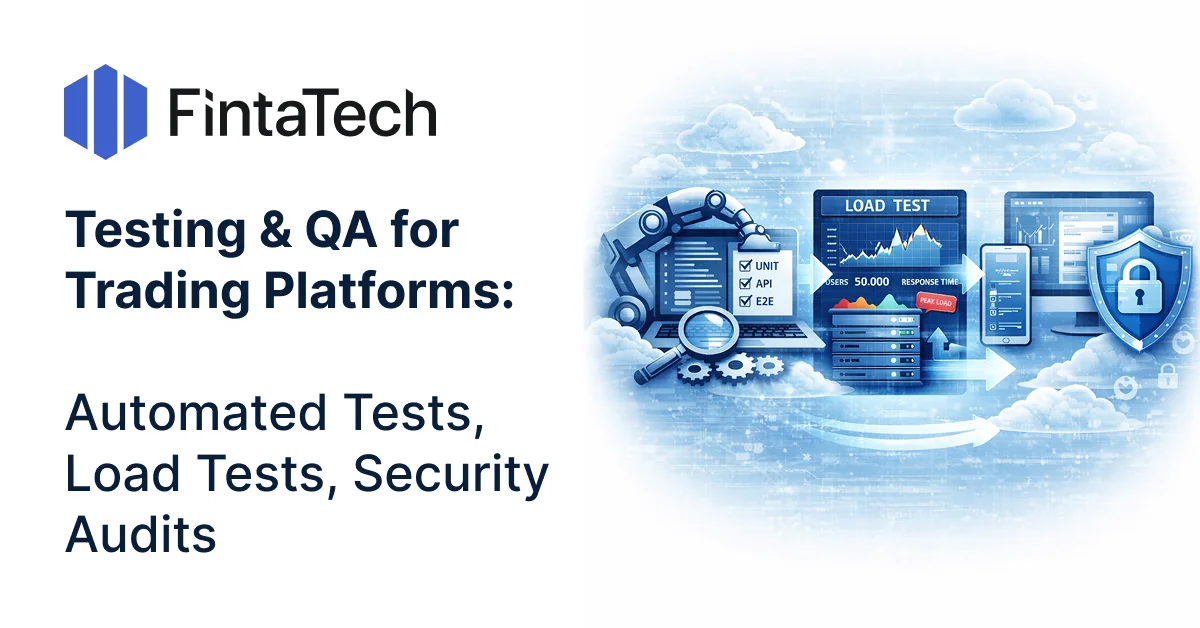
The core goal of automated testing in fintech is not just finding bugs — it’s proving correctness of financial logic with reproducibility. Every layer of the platform requires a distinct testing approach.
Unit Tests: Protecting Financial Logic at the Source
Unit tests in trading systems are most valuable when applied to financial calculation functions: P&L computation, margin requirement formulas, swap/rollover calculations, spread adjustments, and order size normalization. These are deterministic functions with known inputs and outputs, making them ideal for unit test coverage.
A subtle bug in a margin calculation — say, a misapplied leverage multiplier for a specific instrument class — won’t necessarily surface during manual testing or even integration testing. It will surface when a client’s position gets liquidated prematurely, or worse, when it doesn’t get liquidated when it should. Unit tests applied to the margin engine catch these before code ever reaches staging.
Integration Testing: Where Components Speak to Each Other
A modern trading platform is a composition of interconnected systems: the trading terminal (web or mobile), the trading server or backend gateway, the order management system (OMS), the liquidity provider (LP) bridge, the pricing feed aggregator, the back-office and CRM, and the reporting layer. Integration testing validates the contracts between these components.
Practical integration test scenarios include: confirming that a market order submitted through the client terminal correctly propagates through the OMS, reaches the LP bridge with the right symbol mapping and volume, and returns an execution confirmation that the terminal displays accurately. Any failure in this chain — wrong symbol translation, dropped acknowledgment, malformed FIX message — represents a real execution risk.
For platforms using MT4/MT5 bridges, proprietary matching engines, or third-party liquidity aggregators, integration tests should be run against realistic sandbox environments that simulate LP behavior, including partial fills, rejections, and requotes.
API Testing: Validating the Nervous System
Trading APIs — whether REST, WebSocket, or FIX-based — are the nervous system of a trading platform. API testing for trading systems goes beyond validating response codes. It must validate:
- Order state transitions: Submitted → Partially Filled → Filled → Closed, under various execution scenarios
- Tick data streaming consistency: Ensuring WebSocket feeds deliver correct bid/ask spreads, handle reconnection without data gaps, and don’t emit duplicate ticks
- Authentication and session management: Token expiry behavior, concurrent session handling, API key scoping
- Error handling under edge cases: What happens when a client submits an order with volume exceeding available margin, or when the LP connection drops mid-execution?
Automated API testing frameworks like Postman/Newman, REST-assured, or custom Python harnesses can be integrated into CI/CD pipelines to run these validations on every deployment.
End-to-End (E2E) Testing: Simulating the Trader
E2E tests reproduce the full user journey — from login through account funding, instrument selection, order placement, position monitoring, and trade closure — in an environment that mirrors production as closely as possible. Tools like Playwright, Selenium, or Cypress enable browser-based automation of web terminals, while Appium covers mobile trading apps.
For trading platforms, E2E tests are most valuable for regression coverage: ensuring that a new feature or a backend update hasn’t broken the order flow, the position summary, or the charting data. Given how interdependent trading UI components are with live data, E2E tests should use controlled mock environments or staging feeds that produce consistent, repeatable market data.
Regression Testing: The Safety Net for Continuous Delivery
Every deployment to a trading platform carries risk. Regression test suites — comprehensive sets of tests covering known-good behavior — provide the automated safety net that allows teams to ship changes with confidence. In fintech, regression coverage should be highest for order execution paths, risk calculation logic, account balance updates, and authentication flows.
Load Testing Trading Platforms: Preparing for Market Extremes
Standard load testing asks: can the system handle expected traffic? Load testing for trading platforms asks a harder question: can the system handle market conditions that are simultaneously unpredictable and well-precedented?
Modeling Realistic Trading Load
A broker running a forex or CFD platform might see 50,000 active sessions and 200,000 order events in a single hour during a major central bank announcement. The pattern of that load is nonlinear — a burst, not a ramp. Effective load testing for trading platforms must model these burst patterns, not just steady-state throughput.
Load profiles should be drawn from historical data: what was the order submission rate during the COVID market crash? During a major crypto delisting? During the 2021 GameStop event? These are the scenarios that reveal platform limits.
Components to Stress Test
The order matching engine must demonstrate consistent sub-millisecond order acknowledgment latency under burst conditions. If average latency is 2ms but spikes to 400ms under load, that’s a trading quality incident.
The pricing feed pipeline — which ingests raw ticks from LPs or exchanges, applies spread markup, and distributes to clients — must handle high-frequency tick bursts without queue buildup. A backlogged pricing pipeline means clients see stale prices, which creates execution quality issues and potential regulatory exposure.
The WebSocket distribution layer must maintain connections to tens of thousands of simultaneous clients while broadcasting tick updates at high frequency. Load tests should validate behavior at 80%, 100%, and 120% of projected capacity, including graceful degradation and recovery.
The back-office and reporting layer must handle reconciliation runs, position snapshots, and statement generation without impacting trading system performance.
Tools and Approaches
k6, Gatling, and Locust are well-suited to load testing trading APIs, particularly WebSocket-heavy systems. For FIX-based institutional platforms, specialized FIX load testing harnesses are often required. Any load test framework used in fintech should support realistic order sequencing — not just random HTTP requests, but correlated flows: open session → authenticate → subscribe to quotes → submit order → receive fills → close position.
Performance baselines and SLAs should be formally documented. A latency regression is as significant as a functional regression, and CI/CD pipelines should include performance gates that fail a deployment if P99 order latency exceeds the defined threshold.
Security Testing and Audits: Protecting Capital and Client Trust
A trading platform is an unusually attractive target for attackers. It holds client funds, sensitive financial data, trading credentials, and in some architectures, direct access to liquidity provider connections. A successful breach can mean direct financial theft, regulatory sanctions, and irreversible reputational damage.
Penetration Testing
Penetration testing for trading platforms should cover the full attack surface: the web trading terminal, the mobile app, the trading API, the back-office portal, and internal services. Particular attention should be given to:
- Authentication bypass and session manipulation: Can an attacker forge a session token or bypass two-factor authentication to access a client account?
- Order injection and manipulation: Can an unauthorized party submit, modify, or cancel orders by replaying API calls or exploiting insufficient authorization checks?
- Price feed tampering: Is it possible for an attacker with network access to inject false quotes into the pricing pipeline?
- Privilege escalation in back-office: Can a read-only compliance user escalate privileges to modify account balances or override risk limits?
Penetration tests should be conducted by independent third parties at least annually, and after major architectural changes. Findings should feed directly into the development backlog with defined remediation SLAs.
Vulnerability Scanning and Dependency Auditing
Trading platforms use extensive third-party libraries, and the software supply chain is a significant risk vector. Automated vulnerability scanning tools — Snyk, Dependabot, OWASP Dependency-Check — should be integrated into CI/CD pipelines to catch known CVEs in dependencies before deployment.
Infrastructure-level scanning (using tools like Nessus or AWS Inspector for cloud-hosted platforms) should be run continuously against staging and production environments.
Authentication and Authorization Testing
Beyond penetration testing, dedicated authorization testing should validate that every API endpoint and UI action enforces correct access controls. For trading platforms, this means confirming that:
- A client can only view and trade their own accounts
- An introducing broker cannot access end-client data beyond their permitted scope
- Admin functions are unreachable from client-facing API routes
- Rate limiting prevents credential stuffing and brute-force attacks
Data Protection and Compliance Considerations
GDPR, PCI-DSS, and sector-specific regulations impose data protection requirements that should be tested explicitly. This includes encryption at rest and in transit, proper masking of PII in logs and test environments, and access control audits for sensitive data stores. For platforms subject to MiFID II, audit trail completeness and tamper-evidence should be validated as part of each release cycle.
QA as a Continuous Process: Integrating Into CI/CD
The most dangerous misconception in trading platform development is treating QA as a phase. In high-frequency, high-stakes financial systems, quality assurance must be continuous — woven into every stage of the development lifecycle.
A mature fintech CI/CD pipeline runs unit tests and API contract tests on every commit, integration tests on every pull request merge, full regression suites on every deployment to staging, and automated smoke tests immediately after production deployment. Performance gates enforce latency SLAs, and security scans run on every dependency update.
Beyond the pipeline, continuous monitoring completes the loop. Real-time alerting on order failure rates, execution latency spikes, feed staleness, and authentication anomalies allows engineering teams to detect production issues before clients do — or before regulators ask questions.
Chaos engineering practices — deliberately injecting LP connection failures, simulating database failover, or cutting WebSocket connections under load — validate that the platform’s resilience mechanisms work as designed, not just as theorized.
Building and Testing Trading Platforms That Perform Under Pressure
Trading platform QA is not a checklist. It is an ongoing engineering practice that requires deep knowledge of financial system architecture, regulatory context, and the specific failure modes that trading environments expose.
At Fintatech, we develop and deliver trading platforms — web terminals, mobile apps, back-office systems, LP bridges, and matching engines — with QA embedded at every stage of delivery. Our teams have direct experience building and validating mission-critical systems for forex, crypto, CFD, and multi-asset brokers, and we understand what it takes for a platform to perform reliably when markets move fast and margins for error are zero.
If you’re building a new trading platform, expanding an existing one, or looking to strengthen the QA posture of a system already in production, we’d welcome the conversation.
Contact Fintatech to discuss your trading platform development or QA requirements.

Twitter
Linkedin
Facebook